 Agentic Commerce
What agentic commerce means
Agentic commerce covers every commercial transaction in which an AI agent acts on a buyer's behalf: it searches for products, compares offers, assembles the cart and completes the purchase — under the mandate and control of its user.
The operative word is act. A chatbot that recommends a product is shopping assistance; an agent that compares three suppliers, applies your criteria and places the order is agentic commerce. The line between the two is the mandate: the authority, broad or narrow, a user grants their agent to commit money.
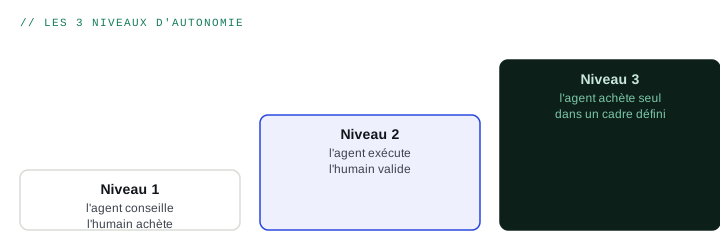
That delegation comes in degrees. Three levels of maturity are visible today:
- Level 1 — the agent advises. It searches and compares; the human clicks and pays. This already happens at scale through answer engines (ChatGPT, Gemini, Perplexity, Claude).
- Level 2 — the agent executes, the human approves. It prepares the whole transaction; the buyer confirms payment in one gesture. This is what the agentic checkouts shipped since late 2025 enable.
- Level 3 — the agent buys autonomously. Within a defined frame (budget, approved suppliers, cadence), it orders without per-purchase approval. The natural horizon for B2B replenishment.
How an agent buys: the five-step journey
Behind a sentence as simple as “order 24 professional drills, delivered this week, best price”, the agent runs a precise technical sequence:
1. Understand the intent
The request becomes workable criteria: product category, quantity, delivery constraint, implicit budget, context (professional here — so net prices, packaging, invoicing).
2. Discover what's on offer
The agent queries whatever it can reach: search indexes, product feeds, merchants' structured data, and increasingly dedicated endpoints (MCP servers, UCP profiles). A catalog no machine can read is, at this step, simply invisible.
3. Compare and decide
Offers are weighed against the criteria: price, real availability, lead times, terms of sale, perceived merchant reliability. Unlike a human, the agent reads everything — including your terms and the shipping costs buried at the bottom of the page.
4. Transact
Then comes the agentic checkout: cart assembly, application of the payment mandate, authentication. This is the most sensitive layer, governed by dedicated protocols such as AP2 that prove the agent was authorised to pay.
5. Handle what comes after
Confirmation, delivery tracking, returns: recent standards cover post-purchase, letting the buyer ask “where is my order?” without ever visiting the merchant's site.

- An agent only buys what it can read: clean, structured data is the absolute prerequisite.
- The payment mandate is the trust lock of the whole structure.
- The customer relationship can play out entirely off your website.
Why this accelerated from late 2025
The concept isn't new; the infrastructure is. In a matter of months, the missing pieces landed one after another:
- Late 2024 — Anthropic publishes the Model Context Protocol (MCP), which becomes the de facto standard for connecting AI models to external systems, ecommerce platforms included.
- September 2025 — OpenAI and Stripe launch the Agentic Commerce Protocol (ACP) and Instant Checkout in ChatGPT; Google unveils the Agent Payments Protocol (AP2) with the major card networks.
- January 2026 — Google and Shopify reveal the Universal Commerce Protocol at NRF, backed by more than twenty retailers and payment players (Walmart, Target, Etsy, Mastercard, Visa, Stripe, Adyen…).
- Spring 2026 — Onboarding gets simpler (Merchant Center integration), capabilities widen (multi-item carts, customer accounts, order tracking) and geographic rollout starts beyond the United States.
In other words: the question is no longer whether agents will buy, but whether your offer will be in their field of vision when they do.
The four protocols shaping the market
Four standards have emerged, often framed as rivals when they largely cover complementary layers:
| PROTOCOL | BACKED BY | PRIMARY ROLE |
|---|---|---|
| UCP | Google × Shopify | Open standard covering the full journey: discovery, cart, checkout, post-purchase. |
| ACP | OpenAI × Stripe | Direct purchase inside a conversation with an AI assistant. |
| MCP | Anthropic | Generic connection between AI models and merchant systems (catalog, stock, orders). |
| AP2 | Google × card networks | Securing agent-initiated payments: mandates, authentication, auditability. |
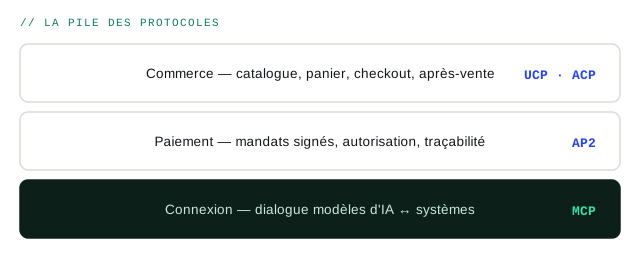
An important nuance: these layers compose. UCP is transport-agnostic and can run over MCP; AP2 secures payment whatever the discovery channel. For a merchant, the right question isn't “which one do I pick?” but “is my data ready to feed any of them?”. Our detailed comparison goes protocol by protocol.
What changes for merchants
Visibility changes in kind
SEO optimised for a human choosing among ten blue links. Facing an agent, there is often a single retained answer. Being “agent-visible” becomes close to a zero-sum game, where data quality outweighs brand recognition. This is the field of GEO (Generative Engine Optimization).
The product page becomes an API
Exact prices, real-time stock, variants, readable terms: everything that was “roughly right” on a product page becomes blocking when a machine reads it. A displayed price that differs from the database, and the agent drops the offer — or worse, keeps it and the transaction fails.
The brand must exist away from its site
If discovery, comparison and purchase happen in a conversational interface, your website is no longer the stage: it's the back office. Differentiation shifts toward what an agent can measure (price, service, reliability, reviews) and what the user explicitly asks for (“from Fabrix, as usual”). Brand preference is won before the conversation.
The B2B case: the natural ground
Agentic commerce gets discussed mostly in consumer terms, yet its most natural ground is B2B, for three structural reasons:
- Purchases are recurring and rational. Restocking consumables against objective criteria is exactly the kind of task one happily delegates — far more so than a pleasure purchase.
- The data is already contractual. Negotiated pricing, per-account terms, free-shipping thresholds: B2B has always structured its commercial conditions. Exposing them to an authenticated agent is a natural extension.
- The ROI is immediate. On the buying side, an agent comparing three suppliers on every order saves hours of admin; on the selling side, a well-exposed agentic channel captures those orders at no marginal sales cost.
The complexity is real (per-customer pricing, minimum quantities, multi-level approval), which is precisely what makes it strategic: B2B platforms that expose these mechanics cleanly to agents will build a lead that's hard to close. Our dedicated B2B guide covers the use cases.
Getting ready, concretely
In order of priority — and of effort-to-impact ratio:
- Clean up product data. Single source of truth, reliable prices and stock, complete attributes. Without this, nothing else holds.
- Deploy structured data. Schema.org (Product, Offer, Organization) across the catalog: it's the first thing any agent reads. See our structured data guide.
- Publish clean feeds. A complete, current product feed (Merchant Center and equivalents) is today the most direct doorway to agentic surfaces.
- Make content quotable. Clear, factual, structured pages — what serves GEO serves your human customers too.
- Experiment with an agent endpoint. An MCP server or UCP profile depending on your platform: the goal in 2026 is to learn, not to migrate everything.
To find out where you stand, our 20-point agent-ready checklist covers all five workstreams.
Want a diagnosis with no blind spots? Our Commerce Agentique experts audit your site against all 20 agent-ready points — product data, structuring, feeds, agent access, measurement — and hand you a prioritised report ranked by effort-to-impact, with a concrete roadmap.
Request a full audit →Frequently asked questions
How does this differ from classic ecommerce?
In classic ecommerce, a human browses, compares and buys on a merchant site. In agentic commerce, an AI agent performs some or all of that journey on the user's behalf, while the user states a need and approves — or delegates — the decision.
Does agentic commerce apply to B2B?
Yes, and it's arguably the most favourable ground: B2B purchases are recurring, rational and based on objective criteria (negotiated prices, availability, lead times) — exactly what an agent optimises well.
Do I have to pick a single protocol?
No. UCP, ACP, MCP and AP2 cover different layers and are designed to compose. The priority for a merchant is clean, structured product data that any of these standards can consume.
Who is liable if an agent buys by mistake?
The framework rests on the mandate: the user defines what the agent may commit, and payment protocols (AP2 in particular) record proof of that authorisation. The merchant remains the merchant of record. The precise legal framing, especially under EU consumer law, is still taking shape.