 Agentic Commerce
The founding objection: “I'm not giving my card to a robot”
It's a healthy instinct, and agentic payment infrastructure is built precisely so you never have to. Two mechanisms handle it: the single-use token and the signed mandate. Understand both and you understand the whole payment layer.
The token: the agent never sees the card
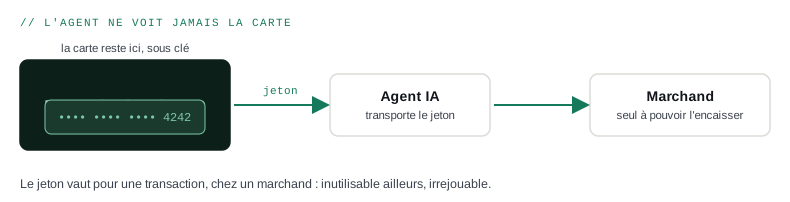
In today's agentic checkouts (ChatGPT's Instant Checkout via ACP, for instance), the payment provider issues a shared token valid for one specific transaction, at one specific merchant. The agent carries that token; only the merchant can convert it into a charge. The card stays with the provider, and the agent handles nothing but a single-use shadow of it — unusable elsewhere, impossible to replay.
The mandate: proof of authorisation
The token settles “how to pay”; the mandate settles “was it allowed”. Formalised by AP2, it comes in two steps: the intent mandate (the frame the user sets: what, how much, from whom, how often) and the cart mandate (the precise transaction, frozen and signed at payment time). That chain of cryptographic proof is what makes autonomous purchasing insurable — and disputes arbitrable.
What merchants must check
- You remain merchant of record. In UCP as in ACP, collection, invoicing, VAT and the customer relationship stay with you. Check that any integration preserves that status.
- Are your providers ready? The agentic payment layer will largely be carried by them (Stripe, Adyen, card networks). Ask about ACP/AP2 support: the answer is a selection criterion.
- Channel cost. Surface commission (OpenAI's ~4% on Instant Checkout) plus usual payment fees: the agentic channel has an acquisition cost, to be arbitrated as such.
- Logging. Keep the full record of agentic transactions (token, mandate where applicable, session): that's your evidence in a dispute.
Fraud and disputes: what changes
Agentic commerce shifts risk more than it increases it. The single-use token removes card theft in transit; in exchange, a new dispute appears — “my agent exceeded what I authorised”. That's exactly what mandates make arbitrable: did the transaction match the signed frame? The detailed legal framework, particularly its articulation with EU consumer law (withdrawal rights, PSD2 strong authentication), is still forming — a topic we track in the news section.
- The agent never sees the card: it carries a single-use token.
- The signed mandate is the proof of authorisation — the key to autonomous purchasing.
- The merchant stays merchant of record; providers carry most of the technical work.