 Agentic Commerce
What the Universal Commerce Protocol is
The Universal Commerce Protocol (UCP) is an open standard co-developed by Google and Shopify and published under Apache 2.0 in January 2026. It defines how an AI agent discovers a merchant's products, negotiates available capabilities, completes a purchase and handles post-sale — without bespoke integration between every agent and every merchant.
Interoperability is the core idea. Before UCP, connecting an AI assistant to a merchant required custom work, multiplied by the number of assistants and merchants. With UCP, the merchant publishes a capability profile once; any compatible agent then knows what it can do there — browse the catalog, build a cart, pay, track an order.
The protocol is agnostic on two counts: platform-wise (no Shopify or Google exclusivity — the specification is public on GitHub) and transport-wise (it runs over REST, GraphQL, JSON-RPC, or even MCP and A2A).
How UCP works
UCP breaks the purchase journey into standardised capabilities that each merchant enables according to their maturity:
| CAPABILITY | WHAT IT LETS THE AGENT DO |
|---|---|
| Discovery | Read the catalog in real time: products, variants, prices, stock. |
| Cart | Build a multi-item cart, just as a human shopper would. |
| Checkout | Complete the transaction through the payment handler the merchant declares. |
| Account linking | Authenticate the customer to unlock their benefits: negotiated pricing, loyalty, free shipping. |
| Order management | Check status, delivery tracking, initiate after-sales. |
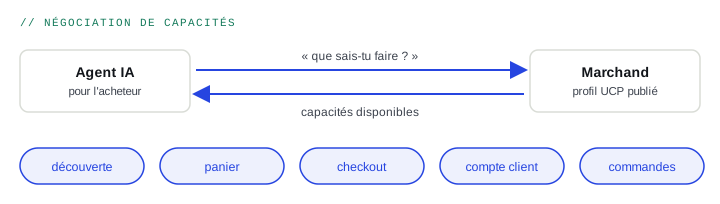
When an agent contacts a merchant, the two perform a capability negotiation — a technical handshake establishing what's possible. A merchant enabling discovery alone stays visible and comparable; one enabling everything becomes buyable end-to-end from a conversation.
{
  "ucp_version": "2026-03",
  "merchant": "fabrix-pro.com",
  "capabilities": [
    "catalog.discovery",
    "cart",
    "checkout",
    "identity.linking",
    "order.management"
  ],
  "payment_handlers": ["stripe", "adyen"]
}
Two governance principles deserve emphasis, because they answer merchants' most common concerns:
- The merchant remains the merchant of record: they collect payment, invoice, handle VAT and own the customer relationship. UCP carries the transaction; it doesn't stand in for it.
- The standard is community-governed: public specification, Apache 2.0 licence, open contributions — the same model as the web's major standards.
Who has adopted UCP
The January 2026 launch came with an unusually broad coalition for a new standard — more than twenty players covering the three essential links:
- Ecommerce platforms: Shopify (co-developer, native integration) and BigCommerce, putting UCP within reach of millions of merchants with no heavy development.
- Retailers: Walmart, Target, Etsy, Wayfair, and in Europe Carrefour — a signal that this reaches beyond the US market.
- Payments: Mastercard, Visa, Stripe, Adyen, underwriting the transaction layer.
On the buying side, UCP powers Google Search's AI Mode and the Gemini apps, as well as Microsoft Copilot's checkout — proof the standard isn't captive to its initiator. Since March 2026, activation runs through a simplified Merchant Center flow, and geographic expansion has begun (Canada, Australia, the UK in spring).
UCP versus ACP, MCP and AP2
Trade press talks about a “protocol war”; the technical reality is more layered:
- ACP (OpenAI × Stripe) is a direct competitor on the conversational checkout layer — the standard for buying inside ChatGPT. Ambitious merchants will likely implement both.
- MCP (Anthropic) sits one layer below: a generic protocol connecting models to systems. UCP can use MCP as transport — they stack rather than clash.
- AP2 (Google × card networks) secures the mandate and the payment, whatever commerce protocol sits above. UCP and AP2 are designed to work together.
For a layer-by-layer analysis, see our protocol comparison.
Preparing for UCP as a merchant
- Solidify the data foundation. UCP exposes your catalog in real time: prices, stock and variants must be right in the database, not just on screen.
- Polish the Merchant Center feed. It's currently the most direct activation path; a complete, clean feed is a prerequisite.
- Check your platform. On Shopify or BigCommerce, compatibility arrives natively; on a custom platform, the public specification lets you implement capabilities one by one, starting with discovery.
- Start measuring now. Isolate traffic from AI surfaces in your analytics so you have a baseline the day agentic transactions reach your market.
- Anticipate B2B. Account linking opens the door to negotiated pricing and per-customer terms — the heart of business-to-business trade. See our B2B guide.
Frequently asked questions
Is UCP only for Shopify merchants?
No. UCP is an open standard under Apache 2.0, independent of any platform. Shopify is a co-developer and integrated it natively, but any ecommerce solution can implement it — BigCommerce did so at launch.
Who is the merchant of record in a UCP transaction?
The merchant. They remain merchant of record: collecting payment, invoicing and owning the customer relationship. Conversational surfaces are sales channels, not commercial intermediaries.
Is UCP available in Europe?
Not officially yet. Rollout began in the United States in January 2026, then Canada, Australia and the UK in spring. No date has been announced for continental Europe — but technical preparation is identical whatever the market, and Carrefour's adoption shows European retailers are already getting ready.