 Agentic Commerce
What the Model Context Protocol is
The Model Context Protocol (MCP) is an open standard published by Anthropic in November 2024 defining how an AI model connects to external systems — databases, APIs, business applications. Applied to commerce, it lets an agent browse a catalog, check stock or place an order through an MCP server exposed by the merchant.
MCP isn't a commerce protocol as such: it's the connection layer beneath. It's often described as “USB-C for AI applications”: a universal socket. The merchant exposes an MCP server once; any compatible model — and practically all are since 2025, with OpenAI, Google and Microsoft joining Anthropic — can plug into it.
How MCP applies to commerce
A merchant MCP server exposes two kinds of capability:
- Resources — what the agent can read: catalog, product pages, stock, pricing terms for the authenticated customer.
- Tools — what the agent can do: search a reference, build a quote, create an order, check its status.
search_products(query, filters)
check_stock(sku, warehouse)
get_customer_price(sku, account_id)
create_order(lines, shipping_address)
track_order(order_id)
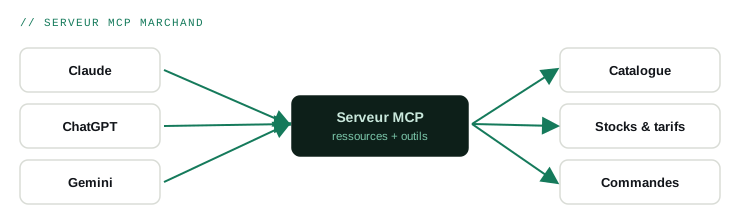
The model's strength is granularity. The merchant decides exactly what to expose, to whom, with what authentication. An MCP server can serve public prices to any anonymous agent, and negotiated terms only to an authenticated customer's agent — a natural fit for B2B.
MCP versus UCP and ACP
This is the most common confusion, and one sentence dissolves it: MCP carries, UCP and ACP describe commerce. MCP says how to talk; UCP and ACP say what to say (a cart, a checkout, an order). Both commerce standards acknowledge this: UCP is explicitly transport-agnostic and runs over MCP, and the ACP specification added MCP support in spring 2026. Building an MCP server today lays the foundation the commerce protocols stack onto.
Building your merchant MCP server
- Start read-only. Exposing product search and stock lookup carries no transactional risk and makes your offer immediately queryable by agents.
- Add customer authentication. This is the value trigger in B2B: negotiated pricing, credit terms, order history — things no public index can offer.
- Open writes gradually. Quotes first, orders next, with guardrails (spending caps, approval) while usage patterns settle.
- Log everything. Every agent call recorded: it's your best learning tool about what agents look for — and fail to find.
Frequently asked questions
Is MCP only for Anthropic's models?
No. Created by Anthropic, MCP became the industry's de facto common interface: the major model providers adopted it through 2025. One MCP server serves every compatible agent, whatever model sits behind it.
Does an MCP server replace my existing API?
No, it dresses it. An MCP server is usually a thin layer over your existing APIs, describing them in a format models understand natively. If your APIs are clean, the MCP server is a short project.
Is it worth it if I'm targeting UCP or ACP?
Yes: both can work with MCP, and the structuring work — what data, what actions, what authentication — is exactly the same. Nothing is wasted.