 Agentic Commerce
The principle: an agent only buys what it can read
All preparation for agentic commerce follows from that sentence. An agent doesn't “see” your site the way a human does: it reads data. An ambiguous price, approximate stock, terms of sale in a scanned PDF — those offers simply don't exist for it. The good news: the workstreams below also serve classic SEO and your human customers. Nothing is wasted, everything compounds.
Workstream 1 — Make the product repository reliable
Before any technique, the data. An agent compares attributes: if your references have inconsistent labels, empty attributes, or prices that differ between database, page and feed, you lose the comparison — or you generate transactions that fail.
- One source of truth (PIM or master database) for labels, attributes, prices and stock.
- Complete attributes: dimensions, materials, compatibilities, packaging — these are the agent's filtering criteria.
- Real-time stock, or at minimum honest stock: “in stock” must mean in stock.
Workstream 2 — Deploy structured data
This is the common language between your site and machines: schema.org on every product page (Product, Offer), the company (Organization) and content (Article, FAQPage). It has its own dedicated guide; what matters here is its position in the order: right after data clean-up, never before — structuring wrong data industrialises the error.
Workstream 3 — Publish clean feeds
The product feed (Merchant Center and equivalents) is currently the most direct doorway to agentic surfaces: it carries UCP activation on Google's side, and the ACP specification also relies on a feed. Completeness, freshness (updated at least daily), and strict consistency with the site are the three requirements.
Workstream 4 — Make content quotable
Agents don't only read the catalog: they assess the merchant. Delivery terms, returns, warranties and support must exist as clear, structured HTML (not PDFs), at stable URLs. Add an llms.txt at the root: near-zero cost, and it's the table of contents you hand to models.
Workstream 5 — Open an agent endpoint
Once the foundations hold, expose direct access: a UCP profile if your platform offers one, an MCP server if you're B2B or on a custom stack — starting read-only (catalog, stock), with no transactional risk. The goal in 2026 is to learn: log agent requests, they'll tell you what agents are looking for.
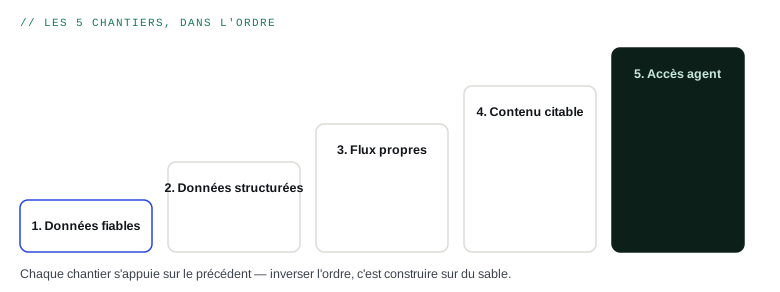
- Reliable data → structured data → feeds → quotable content → agent access.
- Each workstream builds on the previous one; reversing the order means building on sand.
- Workstreams 1 to 4 immediately benefit SEO and human customers.