 Agentic Commerce
What the Agentic Commerce Protocol is
The Agentic Commerce Protocol (ACP) is an open standard launched on 29 September 2025 by OpenAI and Stripe — later joined by Meta — defining how an AI agent completes a purchase with a merchant from within a conversational interface. It's the protocol powering ChatGPT's Instant Checkout.
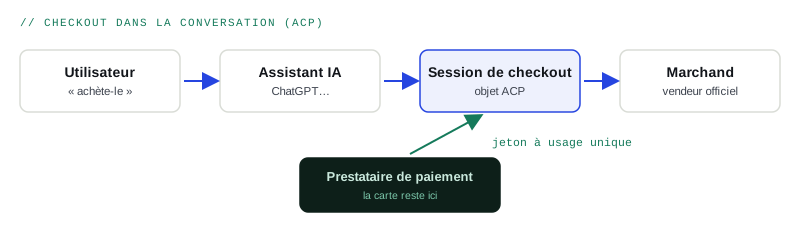
Where UCP starts from discovery and covers the whole journey, ACP starts from the transaction: its central object is the checkout session created inside the conversation itself. The user says “buy it”, the agent opens a session with the merchant, payment is tokenised, the order ships — without ever leaving the chat.
The specification, published on GitHub and maintained by OpenAI and Stripe (beta status, open governance announced), grew quickly: shipping in late 2025, capability negotiation and discounts in early 2026, then cart, product feeds, orders, delegated authentication and MCP support in spring 2026.
How ACP works
ACP defines composable building blocks; the four main ones:
| BLOCK | WHAT IT DOES |
|---|---|
| Agentic checkout | Create, update and complete a purchase session: cart, shipping options, payment. |
| Cart & feeds | Expose the catalog to the agent and manage a cart before checkout. |
| Delegated payment | Pass a secure single-use payment token between buyer, agent and merchant. |
| Delegated authentication | Authorise the agent to act for the customer at the merchant (OAuth 2.0). |
The payment mechanism is worth understanding, because it answers the obvious objection — “I'm not giving my card to a robot”: the agent never sees the card. It carries a single-use shared token, issued by the payment provider, that only the merchant can convert into a charge, for that transaction specifically. The merchant remains merchant of record: they collect, invoice and own the customer relationship.
Adoption and business model
ACP benefits from ChatGPT's reach and Stripe's merchant base. Instant Checkout opened with Etsy sellers, then Shopify merchants (auto-enrolled, at no platform surcharge) and direct brands such as Glossier, Vuori, Spanx and SKIMS. Early figures from the 2025 holiday season showed markedly higher conversion for AI-assistant referred traffic than for classic search traffic.
On the model: the protocol is free and product visibility in ChatGPT costs nothing; OpenAI takes roughly a 4% commission on transactions completed through Instant Checkout, on top of usual payment fees — closer to a marketplace commission, and something to factor into your margin calculations.
ACP versus UCP
This is the ecosystem's real competitive zone: two commerce standards, two coalitions (OpenAI/Stripe/Meta on one side, Google/Shopify and big retail on the other). In practice, the dominant analysis — which we share — is that most ambitious merchants will implement both: ACP to be buyable in ChatGPT, UCP to be buyable across Google's surfaces and beyond. The good news: the data prerequisites are identical. See the full comparison.
Preparing for ACP
- If you're on Stripe: the dedicated suite launched in late 2025 reduces integration to configuration — start there.
- If you're on Shopify: enrolment is automatic; focus on catalog quality, which drives your visibility in recommendations.
- Otherwise: the specification is public and works with other payment providers; a compliant product feed is the first workstream.
- In every case: fold the 4% commission into your pricing or channel strategy, and start tracking ChatGPT-referred traffic in your analytics today.
Frequently asked questions
Do my customers pay more through ChatGPT?
No: the ~4% commission is borne by the merchant, not the buyer. It's up to the merchant to absorb it as an acquisition cost or adjust their pricing strategy.
Do I need to be a Stripe customer to use ACP?
No. ACP is an open standard designed to work with different payment providers. Stripe co-maintains the specification and offers the most direct integration, but adoption isn't conditional on it.
Does ACP work in Europe?
ChatGPT's Instant Checkout rolled out in the United States first. The European timeline isn't officially set, but preparation (product feeds, payment integration) is market-independent and the Shopify/Stripe ecosystem is already widespread in Europe.