 Agentic Commerce
Why B2B is the natural ground for agents
Consumer agentic commerce makes the headlines; business-to-business agentic commerce will make the volumes. Three structural reasons:
- B2B buying is rational and recurring. Restocking consumables against objective criteria — net price, lead time, availability — is the delegable task par excellence. Nobody enjoys redoing it every week.
- The data is already contractual. B2B has always structured its terms: per-account pricing, volume discounts, free-shipping thresholds. Exposing them to an authenticated agent is a natural extension, not a revolution.
- The ROI computes. On the buying side, hours of admin saved on every order; on the selling side, a channel capturing those orders at no marginal sales cost.
Three use cases, by maturity
1. Assisted supplier comparison
A buyer asks their agent to compare three approved suppliers on a given order: net prices, availability, lead times. Prerequisite on the seller's side: a readable catalog and, ideally, account pricing accessible to the authenticated agent. This is the live use case today — and the one where the invisible always lose.
2. Conversational quotes and orders
“Prepare a quote for 40 units delivered week 36”: the agent queries the supplier's MCP server, gets the account price, builds the quote, and turns it into an order once approved. This is level 2 agentic commerce applied to B2B.
3. Autonomous replenishment
Within a defined frame — budget, approved suppliers, stock thresholds — the agent orders on its own. That's the horizon, gated by payment mandates: proof of authorisation becomes the keystone once the human leaves the loop.
B2B-specific challenges — and their answers
| CHALLENGE | ANSWER |
|---|---|
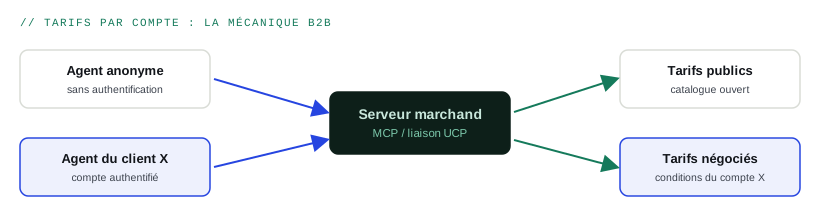
| Per-customer pricing | Account authentication at the agent endpoint (MCP server, UCP account linking): a customer's agent sees that customer's prices, and only those. |
| Quantities and packaging | Expose minimums and multiples in the data (eligibleQuantity) so the agent orders correctly first time. |
| Multi-level approval | The approval chain already exists on the buying side; the agent slots into it (quote → human approval → order) rather than bypassing it. |
| Credit terms and payment | Keep your usual terms (bank transfer, net payment days): agentic commerce doesn't force card payments. |
The B2B action plan
- Make repository and pricing reliable — see the foundation guide: everything follows from it.
- Structure the public offer (schema.org with B2B fields) to exist in open comparisons.
- Expose a read-only MCP server: product search, stock, then account pricing behind authentication.
- Open quotes, then orders, with guardrails (caps, approval).
- Prepare for mandates to enable autonomous replenishment as AP2 reaches your payment providers.
Are you a manufacturer, wholesaler or distributor? Apisell, a French B2B ecommerce platform, natively implements the mechanics described in this guide — per-account pricing, structured catalog, and an MCP server exposing your offer to AI agents.
Discover Apisell →